The Devil Wears Prada 2 Is the Most Frightening Film of the Year
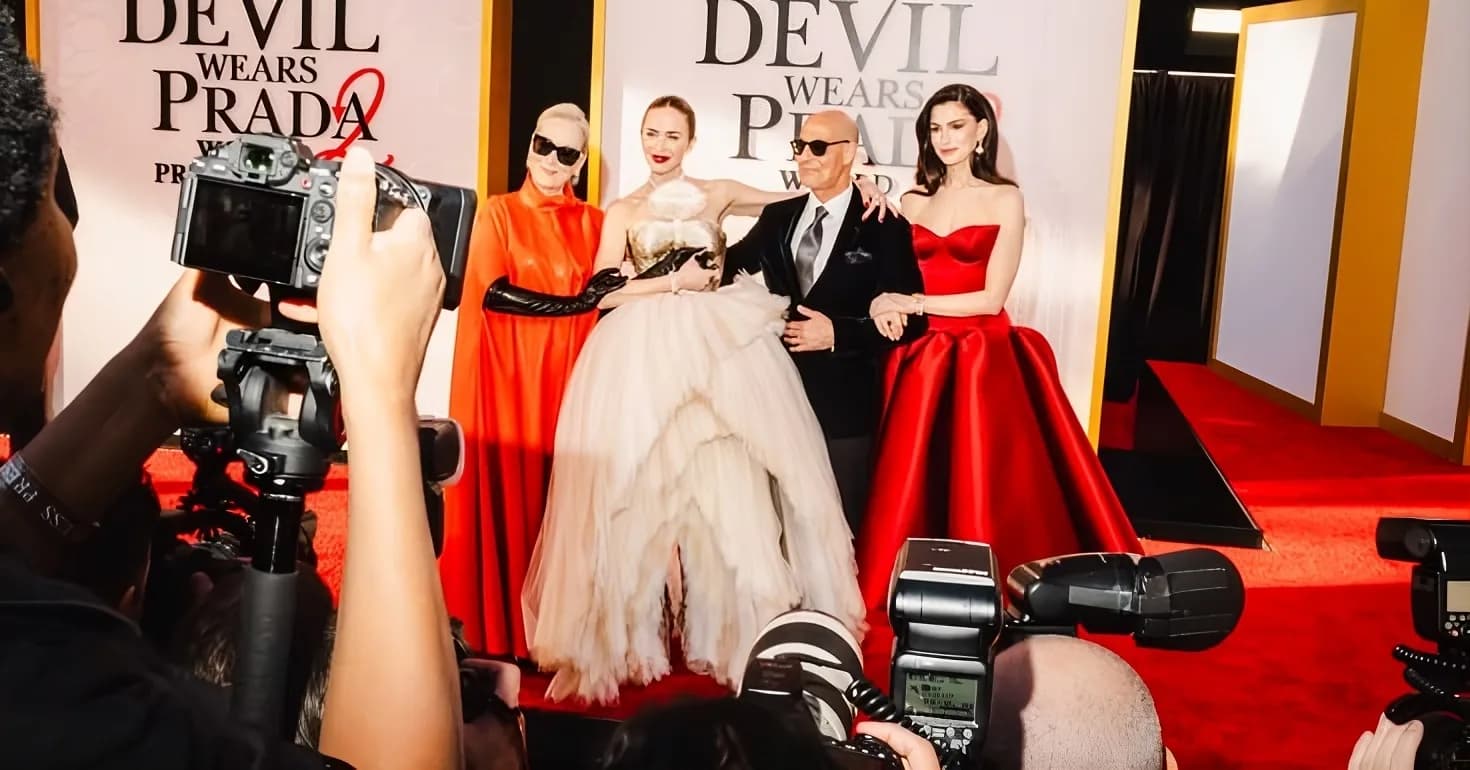
Spoiler Alert. If you haven't watched The Devil Wears Prada 2 and you're planning to, close this tab. Come back after. We promise the article will still be here, and it will hit considerably harder once you've seen what we're talking about.
The Crystal Ball of Algorithms and AI
I recently rewatched the original Devil Wears Prada before sitting down with the sequel, and I made the mistake of letting the nostalgia wash over me and settling in too comfortably. The 2006 film is the heft of physical magazines, the sacred weight of editorial decisions made by humans in the room who revere their craft, a world where Miranda Priestly's opinion alone could move an entire cultural season. Then came the hitting-too-close-to-reality Devil Wears Prada 2, which is why I call it nothing short of a crystal ball, and it is a nightmare, not because of the cast, plot, and direction, which were all pure finesse, but because it is gut-wrenchingly, uncomfortably true. The scene that undoes you arrives almost casually, the new “young” executive filled with “fresh” ideas of optimisation and reducing waste, with his vision for the magazine, Runway’s future, being hyper-data-led, stripped of the costly, slow, irreparable thing called editorial judgement and human-led effort, errors, and development, handing it all over to the near-perfect jury and officers of the court of algorithms and legislators of AI operations.
We often reach for the Pompeii analogy at moments like this, where we see technology advancing at a dangerous pace, lava, and we citizens standing hand in hand waiting for doomsday, but the analogy cannot be more inaccurate, because the denizens of Pompeii did not invite the volcano in. They did not train it with their data and preferences because of convenience, only to let the volcano’s inevitable wrath decide what deserves to survive. We are not being consumed, we are the consumers, and we are consenting at the cost of eventual cultural and cognitive loss. And that realisation is the film’s most haunting depiction.In this piece, we will make our argument for how, in the age of attention, not everything that glitters is gold, and why you might still stand a chance against this villainised volcano called algorithms and AI.
Algorithm the New Tastemaker
The algorithm does not show you what you like, you cannot call it an echo chamber. It builds a model of you, basically profiles you enough to keep your feeds optimised for engagement, and then shows you what you will watch. In Netflix Recommends: Algorithms, Film Choice, and the History of Taste by Mattias Frey, breaking the illusion around algorithms, he takes a closer look at the impact of Netflix’s system on the culture of films and series at the end of Chapter 4. And for another platform, TikTok, the research by Paolo Gerbaudo in TikTok and the Algorithmic Transformation of Social Media Publics: From Social Networks to Social Interest Clusters categorised its audience into two categories, and we are concerned with the category of “clustered publics”, who engage in “TikTokification” and how their online behaviour shapes their interests and taste.So our analysis is that you did not find cottagecore, cottagecore found you, colonised your For You page for four to six months, and then made its way into your wardrobe, apartment, and wishlist, before receding to make room for the next one. Old Money, Quiet Luxury, Clean Girl, Mob Wife, each one a complete identity available for immediate download, no self-examination necessary.

This is not a Western problem dropped onto a foreign shore. Open Instagram in India, and the scroll is flooded with curated Y2K aesthetics, seasonal microtrends of “chatpate” tops and dresses, and viral identities, each moving past at a velocity that makes choice feel almost performative. India’s 3.5–4.5 million creator economy attracts trillion-dollar influencer partnerships that are going to test every last thread’s strength for virality. And this is all elevated further, with every founder, every brand, and every designer being at the mercy of what the feed will finally decide to sell for them, and if there is one conclusion you should take away, it is that the feed does not sell what is always good, it sells what sticks.And pumping into this engine a superfuel, AI tools and their effectiveness, the fashion AI market is projected to expand at a CAGR of 39.12% from 2025 to 2034. There are platforms which will scan millions of social media images to predict demand by colour, shape, and fabric, meaning what a brand finally decides to make next season is already being shaped by what the algorithm decided to amplify last season.The BoF–McKinsey State of Fashion 2024 Survey of global fashion executives highlighted to us that a staggering 73 percent of survey takers said that “Gen AI” will be a priority for their business in the year ahead. From Gen-AI writing assistants for merchants through Shopify, to Ganni using the technology at its Spring/Summer 2024 runway show for an installation that invited guests to ask questions and receive answers curated through Ganni’s reflected point of view, then AI campaign creations from Casablanca, image generators from Midjourney to Nanobanana bypassing the costs and logistics of managing human resources, this was when it was categorised as a “developing technology”. The runway, both the physical one and the metaphorical Runway, is being remade in the process.
What is Lost When a Machine Curates the Beautiful

Fashion has to be understood as an art form which goes beyond being decorative, it is part of the collective memory we share, the one we have all agreed to forget, because perhaps forgetting is more comfortable than reckoning with what is at stake.Consider the historical record plainly. The suffragettes of the early 1900s silently made their point through the engineered visual language of clothing by donning white gowns standing for purity, purple sashes for dignity, and green for hope, deploying fashion as a subconscious communication at a time when women had no official political voice. The sans-culottes of the French Revolution wore loose-fitting civilian dress as a deliberate rejection of aristocratic excess, using their clothes to announce the evolution of social contract theory before the law itself said it. Coco Chanel’s androgynous silhouettes challenged the material architecture of gender constraint. Yves Saint Laurent’s Le Smoking in 1966 put women in trouser suits and argued that the binary was a choice, not a fact.The Black Power movement of the 1960s and 70s reclaimed the Afro and Kente cloth as an explicit rejection of white-centric beauty standards, with fashion as the front line. Vivienne Westwood and the punk movement turned safety pins and political slogan tees into an anti-establishment outcry. None of this was a trend. These were chaos-arousing ruptures created by human imagination and failures provoked by social and political pressure, producing something that did not exist in any dataset, because the data itself was the old world, a moulded mould needing a fresh take.India’s own textile history carries the same charge, and it is equally endangered. The handloom tradition, from Ikat and Jamdani to Chanderi, Kanchipuram silk, and Ajrakh block prints, is not craft for craft’s sake. These weaves carry centuries of community knowledge, political identity, and regional pride encoded in thread. Designers like Sabyasachi Mukherjee, Sanjay Garg of Raw Mango, and Ritu Kumar did not simply revive Indian textiles; they argued through cloth that heritage is not nostalgia, but a living force. Fashion platforms in India have recorded a sharp rise in searches combining “oversized” with “handloom” and “craft detail,” suggesting that beneath the algorithm’s churn, something authentic is still trying to surface.But once heritage enters the For You page, it risks becoming content before it remains culture. The weaver’s wage does not rise with virality, because the algorithm has no metric for dignity. Research has already linked high exposure to personalised algorithmic feeds with declining self-esteem and narrowing cultural visibility. And while AI can now generate campaigns, captions, and even regional-language content at scale, it still cannot manufacture trust, community memory, or lived authenticity. The market is slowly recognising what algorithms cannot replicate: human presence remains culturally irreplaceable.
The Choice That Remains Yours
Miranda Priestly’s cerulean sweater speech did, in fact, tell us the truth about how the world involves itself in fashion every second. It remains one of cinema’s greatest explications of cultural power. The battle of saving and curating taste, foul for some and heavenly for others, is exactly what taste is about, and that is what she fought for throughout the film. But it is haunting how many of us have now turned indifferent to inserting ourselves into algorithms, where our tastes are made up of optimisation over intention, replacing culture with content.Taste is slow. It is built from the films you watched alone at 2 AM, the city you admired but got lost in and hated while travelling, the grandmother’s Kanjeevaram you kept, the vintage find that has no category but feels inexplicably like you. The work of reclaiming it is unglamorous: going offline long enough to be bored, walking into a shop with no recommendation engine, noticing what you reach for when no one is watching, when nothing is learning from the gesture. That reaching, instinctive, unoptimised, and entirely yours, is the beginning of taste.Actually, don’t listen to us. Go figure it out yourself. That’s rather the point.

Vanshika Verma
Founder & Editor-in-Chief
Vanshika Verma founded Strategist’s Cut to explore the intersection of fashion, law, and capital. Drawing from research training and experience inside a fashion brand, her work examines how influence, markets, and cultural power are structured. With a background in legal analysis, market research, and digital media, she approaches publishing as a way to decode the systems shaping fashion, luxury, and business.