Inside the Met Gala 2026 Theme “Fashion Is Art” Through the Lens of Art Law
2026’s Monday Met arrived and went, but what stays afterwards are the looks the stars leave behind as they walk the carpet. And 2026’s “Costume Art,” with the dress code being “Fashion Is Art,” was perhaps one of the most exciting themes in recent years. A celebration of the forthcoming opening of the museum’s Condé M. Nast Galleries, alongside an homage to the original “Museum of Costume Art,” an independent institution established in 1937 before being absorbed and renamed by the Met in 1946, the theme carried history, legacy, and artistic possibility stitched into its very foundation.
The Met Gala already exists as a platform where fashion is interpreted as art. But making that the central tenet this year meant we expected artistic fireworks. Leonardo da Vinci-ism, Pablo Picasso-centred eccentricism, Michelangelo’s sculpturism, Gustav Klimt’s harmonic colours, Claude Monet’s nature-soaked pastel elegance, these are merely some references from the top of our heads. And while we remained in love with the theme and the looks, well, some of them, the legal instinct quietly kicked in. Amidst the spectacle, gardened with thousands of camera flashes a minute, the media value generated, the Getty Images tags, the Instagram posts, and the circulation of these looks across the internet, at the centre of it all still stands the artwork these costumes were inspired by. So when exactly does Art Law begin to play out its colours? That is the purpose of this article: to explore what exactly we begin to see when we view these looks through the lens of Art Law and Media Law, and how couture, museums, artist estates, intellectual property, and celebrity culture all begin operating within the same ecosystem through both U.S. and Indian legal frameworks.
How Art Inspiration Enters Legal Territory
“Fashion Is Art,” the theme sounds perfectly romantic, almost as if we were handed a ticket to a time machine, one through which we could witness how beloved art pieces and legendary artists would interpret the fashion of today. But what also exists today are the millions and billions of views generated, the revenues attached to visibility, and the legal threads invisibly intertwined into every fit, ensuring that the stylists, the designers, the celebrities, and the brands all walk away winning, and not served with legal notices. Every time a designer references a painting, an artistic movement, a sculpture, or any historic aesthetic archive, they quietly enter the territory of intellectual property, cultural ownership, media circulation, and commercial visibility.
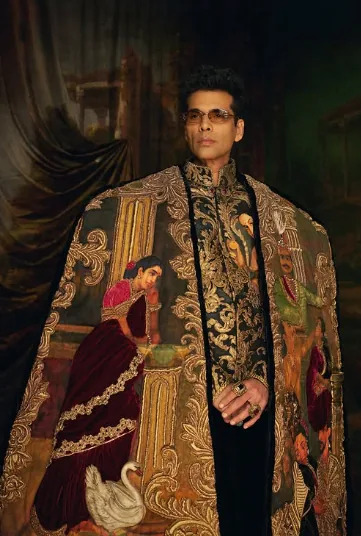
Karan Johar at the Met Gala, his look, inspired by Raja Ravi Varma’s paintings, was designed by Manish Malhotra and styled by Eka Lakhani. The donned ensemble carried the Kerala artist’s imagery across hand-painted surfaces, those neat zardozi borders, memorable three-dimensional pillars, lotuses and swans, alongside an artisanally hand-painted jacket lining. And as Johar himself remarked, Raja Ravi Varma gave India its most elegantly enduring image of itself. It is precisely this sentiment that attracts both legal and cultural fascination. Because the moment an artist’s visual language becomes wearable, photographed, reposted, archived, and circulated before global eyes, the question quietly emerges: who owns the afterlife of inspiration when so many hands brought that creation to life? Legally, Johar’s look enters conversations surrounding copyright duration, adaptation rights, artistic interpretation, and personality-driven commercialization. Since Raja Ravi Varma’s works largely fall within the public domain due to the expiry of copyright protection, the artistic references themselves may be freely reinterpreted. Yet the moment those references are transformed into a couture piece generating Media Impact Value (MIV), editorial circulation, brand partnerships, and commercial visibility, the legal ecosystem expands into fashion contracts, image licensing, publicity rights, and media exploitation rights.
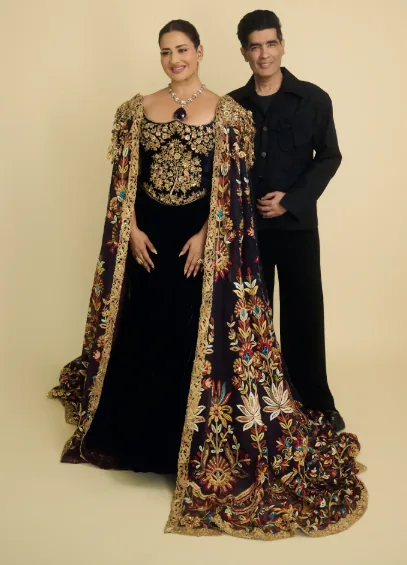
The same string of conversational violin is struck through Sudha Reddy’s ensemble, again created by Manish Malhotra and stylist Mariel Haenn, built around the Tree of Life motif drawn from the artistic language of Kalamkari traditions in Andhra Pradesh and Telangana. The veins of the outfit, the Kalpavriksha, ran through the central composition, while the Palapitta, always associated with Telangana’s Bathukamma festival, appeared alongside Jammi Chettu and Tangedu, plants tied deeply to ritual practices and seasonal cycles. And when we look at the historic value, Kalamkari textiles historically functioned as narrative panels carrying mythology through cloth itself. The tales of sun and moon symbols referenced harvest and festival calendars, embedding regional memory directly into couture. Here, however, the legal layers become far more nuanced because the inspiration is no longer only artistic, it becomes regional, emotional, cultural, and community-linked. And the moment such craftsmanship enters a global commercial platform like the Met Gala, the question is no longer simply “who designed the outfit?” but rather, “what exactly within this outfit deserves protection, and who is entitled to seek it?”
Because tomorrow, if another luxury house replicates Karan Johar’s Raja Ravi Varma-inspired hand-painted visual language or Sudha Reddy’s Kalamkari-rooted Kalpavriksha narrative placement, the same ritual symbols, lotuses, swans, embroidery arrangements, or regional storytelling translated into couture silhouettes, protection may be sought through copyright over the final artistic expression, moral rights under Section 57 of the Indian Copyright Act against distortion or lack of attribution, GI-linked concerns surrounding regional crafts, and media law protections over the monetizable circulation of the looks themselves, from Getty Images and editorial covers to campaigns, AI reproductions, and celebrity-linked commercial visibility generated through the Met Gala itself.

So who owns what? Emma Chamberlain’s hand-painted Mugler gown, created through references to Vincent van Gogh, Edvard Munch, and archival Mugler designs, borrowed from expressionism, colour language, emotional atmosphere, and painterly movement rather than directly reproducing singular artworks. This is why Van Gogh and Munch largely fall within the public domain, because under Section 102 of the U.S. Copyright Act of 1976 and Sections 13 and 22 of the Indian Copyright Act, 1957, copyright protection eventually expires, generally life plus 70 years in the U.S. and life plus 60 years in India, and copyright protects the specific expression of an artwork, not the artistic movement itself. But Mona Patel’s Dolce & Gabbana “Renaissance Genius” entered a more layered legal territory. Crafted for the house’s first Met appearance in six years, the ensemble featured a sepia-toned silk gazar cape titled “Veil of Genius,” carrying direct references to the Vitruvian Man, scribbled manuscripts, portrait studies, and the unmistakable gaze of the Mona Lisa. Beneath it sat “Anatomy of Genius,” reportedly requiring official digital rights clearances because Italy’s Cultural Heritage Code continues regulating the commercial and digital use of nationally significant artworks beyond ordinary copyright expiration.
What This Really Means
Perhaps that is the real significance of this year’s “Fashion Is Art” theme. It was not merely asking celebrities to dress artistically. It forced us to confront how inspiration travels, who gets credited when heritage becomes luxury, where the line between homage and exploitation begins, and how the law quietly follows creativity everywhere it goes. What makes the Met Gala so fascinating is that beneath all the glamour, embroidery, flashes, and spectacle, it quietly revealed how fashion today no longer exists separately from art, law, media, and commerce. A dress is no longer merely a dress. It can simultaneously become a copyrighted artistic expression, a cultural archive, a commercial campaign asset, a museum-worthy object, a regional identity marker, and a globally circulated media property within minutes of stepping onto the carpet.

Vanshika Verma
Founder & Editor-in-Chief
Vanshika Verma founded Strategist’s Cut to explore the intersection of fashion, law, and capital. Drawing from research training and experience inside a fashion brand, her work examines how influence, markets, and cultural power are structured. With a background in legal analysis, market research, and digital media, she approaches publishing as a way to decode the systems shaping fashion, luxury, and business.